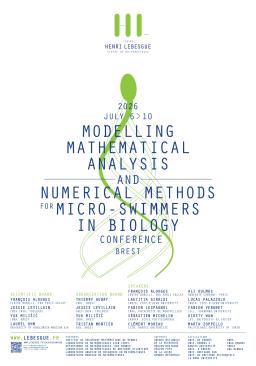
Abstract Book of the conference :
Modelling, Mathematical Analysis and Numerical methods for Micro-Swimmers in Biology
organizing committee:
Thierry Aubry (IRDL, Brest)
Jessie Levillain (CNES - INSA, Toulouse)
Vuk Milišic (LMBA, Brest)
Tristan Montier (GGB, Brest)
Brest, July 2026
Contents
1 Introductory Lectures
1 Introductory Lectures
1.1 Sébastien Michelin (Monday 14:00–15:30)
1.2 François Alouges (Monday 16:00–17:30)
2 Plenary Talks
2.1 Laetitia Giraldi (Tuesday 10:00–11:00)
2.2 Fabien Lespagnol (Tuesday 11:15–12:15)
2.3 Clément Moreau (Tuesday 14:00–15:00)
2.4 Ali Oulmas (Tuesday 15:15–16:15)
2.5 Lucas Palazzolo (Wednesday 10:00–11:00)
2.6 Fabien Vergnet (Wednesday 11:15–12:15)
2.7 Kirsty Wan (Wednesday 14:00–15:00)
2.8 Marta Zoppello (Wednesday 15:15–16:15)
3 Contributive talks
3.1 Julien Le Dreff (Tuesday 16:45–17:30)
Schedule Table
1 Introductory Lectures
1.1 Sébastien Michelin (Monday 14:00–15:30)
Title: Self-organisation and rheology of sheared phoretic suspensions
Abstract: Micro-swimmers propel in viscous fluids at such scales that the effect of inertia is subdominant to that of viscous stresses. From a fundamental, but also practical, point of view, this has some major consequences that profoundly impact the morphology and behavior of biological species. In this presentation, I review some of the most important properties of Stokes flows applicable to self-propelled systems including fundamental theorems that provide quantitative insight on the propulsion characteristics. Among the subjects covered, I focus specifically on the Lorentz and Purcell theorems, which have been cornerstones of the study of micro-swimmers from a fluid dynamics point of view, and provide illustrations of the minimum requirements imposed on micro-swimmers in inertia-less flows.
1.2 François Alouges (Monday 16:00–17:30)
Title: Mathematics of Microswimming: From Control Theory to Bifurcations in Infinite-Dimensional Dynamical Systems
Abstract: This talk continues the one by S. Michelin. We first review several mechanisms proposed in the literature to circumvent the Scallop Theorem, then focus on the common analytical tools from Control Theory used to study them. In particular, we discuss Lie brackets and Chow’s Theorem, together with their consequences for locomotion at low Reynolds number.
We also present how the search for optimal swimming strokes can be formulated as an isoperimetric problem. Finally, we address mathematical issues arising in the modeling of flagellar motion in sperm cells, and discuss open questions related to the actuation mechanisms of molecular motors.
This presentation summarizes joint works with A. Lefebvre-Lepot, J. Levillain, I. Anello, A. DeSimone, D. Agostinelli, P. Weder, and G. DiFratta.
2 Plenary Talks
2.1 Laetitia Giraldi (Tuesday 10:00–11:00)
Title: Mathematical challenges in magnetic microrobotics: controllability, optimal control, and multi-swimmers systems
Abstract: This talk addresses the mathematical foundations underlying the control of magnetic microrobots. After a brief introduction, we investigate the controllability of a magnetic robot, framing it as a geometric control problem and revealing intrinsic controllability obstructions. We then present optimal control formulations for trajectory planning, with a focus on minimizing time to reach a target while satisfying dynamic constraints. The third part introduces magneto-elastic swimmers, modeled via an Arbitrary Lagrangian-Eulerian framework coupling fluid dynamics, structural elasticity, and rigid body mechanics to simulate magnetically driven locomotion in confined geometries at low Reynolds number. Finally, we tackle the multi-agent control problem, where a single global magnetic field must simultaneously steer several robots, a challenge that combines underactuation.
2.2 Fabien Lespagnol (Tuesday 11:15–12:15)
Title: A New Computational Framework for Fluid–Structure Interaction of Slender Bodies Immersed in Three-Dimensional Flows
Abstract: Microswimmers such as sperm cells and bacteria, as well as ciliated epithelial cells involved in mucociliary transport, rely on slender structures like flagella and cilia to generate motion and drive fluid transport. These structures are characterized by a very high ratio between their longitudinal length and their transverse dimensions, motivating reduced-order modeling approaches in which the kinematics and dynamics of the structures are described along their centerline. This leads to one-dimensional equations for the structure, coupled with a surrounding three-dimensional viscous fluid. However, coupling a one-dimensional structure with a three-dimensional fluid is not straightforward. It requires the introduction of a codimension-two trace operator, which in turn imposes additional regularity conditions on the fluid solution that are generally not satisfied a priori.
In this talk, I introduce and analyze a mathematically sound approach for modelling and solving three-dimensional/one-dimensional fluid–structure interaction problems. The main idea is to combine a fictitious domain approach with the projection of the kinematic constraint onto a Fourier-based finite-dimensional space defined along the structure centerline. The discrete formulation is based on the finite element method and a semi-implicit treatment of the Dirichlet–Neumann coupling conditions, employing a partitioned procedure for the resolution of the fluid–structure interaction problem.
2.3 Clément Moreau (Tuesday 14:00–15:00)
Title: How extensible bodies swim: bending-compression coupling at low Reynolds number
Abstract: Undulatory slender objects are instrumental in the hydrodynamics of swimming at low Reynolds number, from eukaryotic flagella and cilia to artificial microrobots, because they enable non-reciprocal deformation cycles, which are famously necessary for locomotion at this scale.
In most theoretical locomotion models, these slender bodies are assumed to be inextensible, and this is a reasonable assumption. Yet several microorganisms and artificial microrobots display large compression and extension. The role of this degree of freedom in microswimming is somewhat overlooked.
In this talk, I present recent results that explore the role of compression in low-Reynolds-number locomotion. I theoretically study the coupling between bending and compression shape modes, using a geometrical formulation of microswimmer hydrodynamics to deal with the non-commutative effects between translation and rotation.
Interesting results on bending-compression coupling can be inferred by introducing a minimal model in the spirit of the Purcell swimmer and by considering small-amplitude expansions. In particular, within the framework of resistive force theory, compression-bending coupling allows net locomotion even under isotropic drag, while this is impossible for inextensible swimmers.
If time permits, I then give an outlook on elastohydrodynamics of compressible slender bodies, based on numerical simulation using an N-segment formulation, with applications to modelling the behavior of Lacrymaria olor.
2.4 Ali Oulmas (Tuesday 15:15–16:15)
Title: Swimming Microrobots: From Magnetic Microswimmers to Medical Navigation in the Brain
Abstract: Locomotion at the microscopic scale opens promising perspectives for the design of medical devices able to navigate through complex, confined, and highly viscous environments. In this context, microswimming robots provide a rich example of how low-Reynolds-number fluid mechanics, control theory, geometric modeling, fluid–structure interaction, and experimental constraints come together.
This talk presents two families of microrobots developed in different contexts. The first part focuses on magnetic microrobots, whose propulsion and steering rely on externally applied magnetic fields. These systems illustrate fundamental questions related to the control of artificial microswimmers, the modeling of their motion in viscous fluids, and the transition from theoretical description to experimental validation. The second part discusses the microrobot developed at Robeaute, designed to navigate within soft biological tissues, in particular the brain, for minimally invasive medical applications.
2.5 Lucas Palazzolo (Wednesday 10:00–11:00)
Title: Optimization of microswimmers by Bayesian Optimization
Abstract: Many challenges arising in microswimming can be reformulated as optimization problems. Examples include the search for efficient swimmer shapes, the design of control strategies for trajectory tracking, and the compensation of wall-induced hydrodynamic effects.
A major difficulty is that evaluating the objective function often requires computationally expensive numerical simulations. This is particularly true when realistic environments involving walls, obstacles, or hydrodynamic interactions are considered. Furthermore, the objective function is frequently available only through large simulation codes acting as black boxes, while gradient information is either unavailable or expensive to compute due to the complexity of the coupled dynamical systems involved.
Bayesian Optimization offers a natural framework for addressing these challenges. By constructing a probabilistic surrogate model of the objective function, it enables the efficient exploration of the parameter space while reducing the number of costly simulations.
In this contribution, we investigate the use of Bayesian Optimization for several optimization problems in microswimming, including shape optimization and trajectory-following control. These examples illustrate how Bayesian Optimization provides a versatile and computationally efficient approach for tackling a broad range of problems.
2.6 Fabien Vergnet (Wednesday 11:15–12:15)
Title: Activity models for the interaction of cilia with a viscous fluid
Abstract: Cilia and flagella are motile elongated structures involved in swimming and transport mechanisms that arise in many living organisms. Flagella are used by microswimmers such as sperm cells or bacteria for motility at low Reynolds number, while cilia are involved in the transport of proteins, nutrients, or dust inside larger organisms. At the origin of all these mechanisms are two essential ingredients: the capacity for cilia and flagella to modify their shapes by generating internal stresses, and the strong reciprocal interaction with the surrounding fluid.
Both aspects have been studied in several works, with very different strategies. Cilia can either be modeled as one-dimensional elastic structures with self-oscillatory and sliding-regulation mechanisms, or as three-dimensional structures with a discrete representation of their internal biological components. In the first case, the coupling with the surrounding three-dimensional fluid is often taken into account numerically with slender-body theory. In the second case, the fluid–structure interaction is well resolved but the discrete model for cilia is not suitable for mathematical analysis and introduces many parameters that may not be accessible in experiments.
Unlike previous works on cilia and flagella, we propose a model that fits in the framework of continuum mechanics. In the context of two-dimensional or three-dimensional elasticity, the model is based upon the definition of a suitable Piola–Kirchhoff tensor mimicking the action of the internal components that induce the motility of the structure. Moreover, the framework of continuum mechanics enables full consideration of the strong interaction with the surrounding fluid. During this presentation, we show that the present model is suitable for both mathematical study and numerical simulation of fluid–structure interaction problems involving active structures and low-Reynolds-number flows. We also discuss synchronization between neighboring cilia.
2.7 Kirsty Wan (Wednesday 14:00–15:00)
Title: Mechanisms of microscale motility
Abstract: How do diverse organisms coordinate complex movement without centralized control? In this talk, I explore how microscale motility and navigation emerge from the oscillatory dynamics of motile cilia across multiple species. Connecting sub-cellular biophysics to whole-organism behavior, we combine live imaging, micro-manipulation, and computational modelling to dissect the complex waveform dynamics of ciliary beats and their impact on swimming and flow generation.
We discuss physical and biological mechanisms of interaction that lead to different forms of coordination, including metachronal coordination among diverse ciliated structures, and the influence of mechanical and electric field perturbations. We explore how systematic variations in these waveforms across a low-dimensional manifold of shapes produce self-propulsion. We examine how symmetry-breaking within these dynamic ciliary gaits enables steering in both two and three dimensions, offering a generalized framework to predict how distinct appendage actuation strategies shape locomotion across ciliated systems.
2.8 Marta Zoppello (Wednesday 15:15–16:15)
Title: Microswimmer controllability trends: the role of deformation, constraints, and interaction
Abstract: Recent years have witnessed significant progress in the mathematical modeling and analysis of microswimmers, motivated by both theoretical challenges and applications in microrobotics and biological systems. This talk presents several recent microswimming models, with particular emphasis on minimal microswimmers with variable length and elasticity, systems of interacting microswimmers swimming collectively, and the dynamics of a microswimmer constrained by a no-slip planar wall.
For each of these settings, the underlying mathematical framework is described, highlighting the influence of geometric constraints, hydrodynamic interactions, and boundary effects on the resulting dynamics. Special attention is devoted to controllability properties, with the aim of understanding whether arbitrary motions or configurations can be achieved through admissible shape changes or cooperative interactions.
The discussion provides a unified perspective on how swimmer design, collective behavior, and environmental effects contribute to controllability at low Reynolds numbers, offering insight into both the theory and the design of efficient artificial microswimmers.
3 Contributive talks
3.1 Julien Le Dreff (Tuesday 16:45–17:30)
Title: Moving backward to go faster: Diatom-inspired sliding reveals efficient modes of locomotion
Abstract: Across biological scales, from sperm cells to whales, locomotion commonly relies on undulatory gaits, in which traveling deformation waves interact with the surrounding fluid to generate thrust opposite to the direction of wave propagation. In viscous environments, microorganism locomotion is classically understood in terms of undulatory bending of slender filaments such as flagella, with optimal propulsion achieved when the deformation wavelength is comparable to the swimmer length. Inspired by diatom colonies, we identify a fundamentally different swimming mechanism based on sliding between neighboring elements within a chain. We show that sliding between stacked elongated cells generates internal shear that drives propulsion opposite to classical undulatory swimming, while achieving higher speeds and greater energetic efficiency. Remarkably, optimal performance occurs at wavelengths much larger than the chain length and at cell aspect ratios consistent with those observed in natural diatom colonies, suggesting that hydrodynamic efficiency may constitute an evolutionary selective pressure in diatom chains. Together, these results identify sliding as a previously overlooked mode of locomotion in multicellular assemblies.